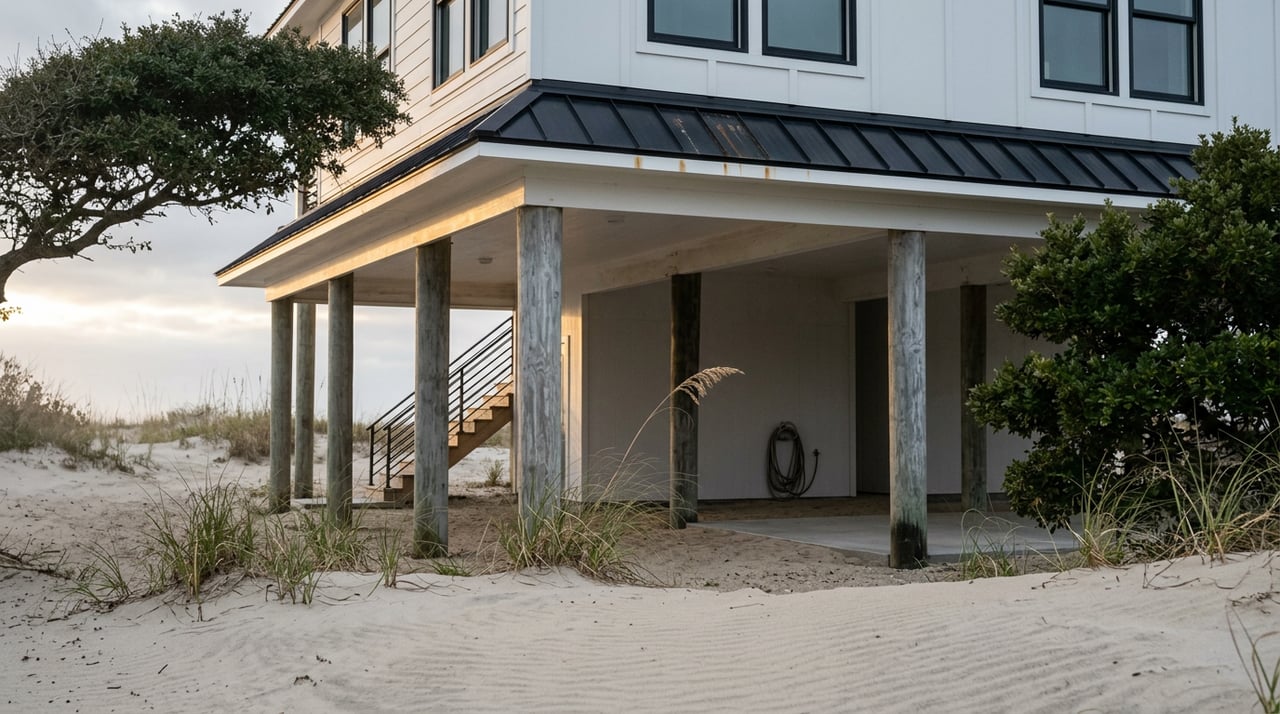
Two homes go up for sale in Carova this fall. Both are frame construction, both sit within a few hundred feet of the Atlantic, both list in the high six figures. On paper, a buyer comparing them side by side is choosing between square footage, bedroom count, and how far the walk to the beach really is.
The listing sheet alone may not show what the flood insurance bill will be. A single letter on a federal flood map can make a major difference, alongside the property's elevation and construction. In Carova, understanding how those factors interact matters more than focusing on the map letter alone.
The Zone Congress Decided For You
Carova sits inside a Coastal Barrier Resources Act zone, a designation Congress created in 1982 to discourage development on undeveloped coastal barrier land by cutting off federal money, including flood insurance backed by the National Flood Insurance Program. The U.S. Fish and Wildlife Service, which administers the law, is direct about the practical effect: NFIP coverage is generally off the table for structures inside these zones, with an exception carved out for homes that were built, or permitted and under construction, before the prohibition date took effect in the area.
That grandfather clause matters if you're looking at an older cottage. It does not help anyone buying a lot or a newly built home, which describes a large share of what's currently for sale along Ocean Pearl Road and the interior streets behind it. For those properties, private flood insurance isn't a backup option. It's the only option.
Three Letters, One Address-Specific Quote
Once NFIP is off the table, the flood zone designation on the property still matters, because private carriers price coverage by how exposed the structure is to wave action and elevation. In Carova, the three zone letters are a starting point for understanding mapped exposure, but they do not determine a premium on their own.
| Flood Zone | What It Means | How to Estimate |
|---|---|---|
| VE | High-velocity wave zone, mostly oceanfront and semi-oceanfront | Get an address-specific quote |
| AE | Inside the 100-year floodplain, lower velocity | Get an address-specific quote |
| X (often Shaded-X in Carova) | Outside the mapped floodplain | Get an address-specific quote |
Premiums vary by property, so an address-specific quote is more useful than a general estimate. Insurance agencies writing coverage for Outer Banks coastal property have noted that a $600,000 oceanfront home in Currituck County near Corolla can carry $10,000 to $20,000 a year once you stack homeowners coverage, the state wind pool, and flood insurance together, with the flood layer alone often landing between $2,000 and $6,000 depending on elevation and construction. That's the current market as of mid-2026, and it's been climbing. Standard carriers have pulled back from writing new coastal business in Currituck and neighboring counties over the past two years, which has narrowed the field of insurers willing to quote CBRA properties at all.
That helps explain why active Carova listings may highlight the flood zone as a selling point rather than leave it in the disclosures. A lot advertised as sitting in an X zone may be marketed on the expectation of lower insurance costs, but the actual premium still calls for an address-specific quote.
Why a Single Average Doesn't Describe This Market
One tally of roughly 70 active Carova listings puts the average price around $450,000. That number is real, but it's an average of two markets that have almost nothing in common, and the spread between them is wide enough to make the average misleading on its own.
At the low end, small two and three bedroom cottages on the soundside start in the $170,000 range, many built in the 1970s through 1990s when the area was first settled. Vacant lots run even lower, with prices beginning around $20,000 for interior parcels. At the high end, oceanfront homes along Ocean Pearl Road routinely start at $900,000 and climb from there, often in the 8 to 12 bedroom range built specifically for rental income.
Square footage explains part of that gap. Flood zone explains the rest. A soundside cottage sitting well back from the ocean is far more likely to fall in an X zone with a modest insurance bill. An oceanfront home built to capture rental income is far more likely to sit in VE, where the insurance math changes the entire ownership equation regardless of what the home appraises for. When you compare two Carova properties, you're not just comparing homes. You're comparing which side of that flood-zone line they fall on.
The Rest of the Utility Bill Nobody Mentions
Insurance is the biggest zone-driven cost, but it's not the only expense that comes with buying in a 4WD-only, off-grid corridor. Every Carova home relies on a private well and septic system rather than municipal water and sewer, since neither exists north of the pavement. There are no fire hydrants. Contractors, electricians, and plumbers working on a Carova build all need their own 4WD vehicles just to reach the site, which can add time and cost to any renovation or repair compared to a project in town.
There's also a smaller, more predictable line item: if you plan to park on the beach strand during the season, Currituck County requires a beach parking permit. For 2026, that runs from the second Saturday in May through the last Saturday in September at $50 per week, with a cap of 300 permits sold per week online. Property owners can skip that cost with a free Currituck County Access Permit tied to the property itself. It's a modest number next to the insurance conversation, but it's one more thing that catches out-of-state buyers off guard if nobody mentions it before closing.
Before You Write the Offer
The flood zone question is answerable well before you're under contract, and it should be, given how much it can move your real budget. Before making an offer on a Carova property, ask for or request the following:
- The property's current FEMA flood zone determination, in writing, not just a verbal estimate
- An existing elevation certificate, if one has already been prepared by a licensed surveyor
- Whether a Letter of Map Amendment is realistic for the parcel, which can reclassify a property to X if it sits above the mapped base flood elevation
- At least one private flood insurance quote specific to the address and its zone, not a general estimate for the area
- Documentation of the structure's build date, in case it qualifies for NFIP under the CBRA grandfather provision
None of this changes what the home is worth to you personally. It changes what it will actually cost you to hold, which is the number that matters once you're several years into ownership rather than at the closing table.
A Few Questions Worth Asking Directly
Can I get standard federal flood insurance anywhere in Carova? Only if the structure was built, or permitted and under construction, before the CBRA prohibition date took effect for that area. New construction and most existing homes rely on private flood carriers instead.
Does an X zone mean I'll never flood? No. It means the property sits outside the mapped 100-year floodplain, which is why why premiums run low when it's purchased anyway. Storms don't always respect the map.
What's a LOMA, and is it worth pursuing? A Letter of Map Amendment is a FEMA process that can reclassify a property from a higher-risk zone to X if a survey shows it sits above the base flood elevation. It requires a licensed surveyor and isn't guaranteed, but for a property near the zone boundary, it can be worth the cost of finding out.
Carova rewards buyers who do their homework before they fall in love with a view. The list price gets you in the door. The flood zone letter tells you what happens after you're inside.
If you're weighing a lot, a cottage, or an oceanfront build in the 4x4 corridor and want a straight read on what a specific property's flood zone means for your numbers, Jason Summerton has spent his career coordinating exactly this kind of decision for buyers who aren't standing on the sand themselves. Let's Connect.
This article is general information, not legal, tax or financial advice. Consult a qualified professional about your situation.