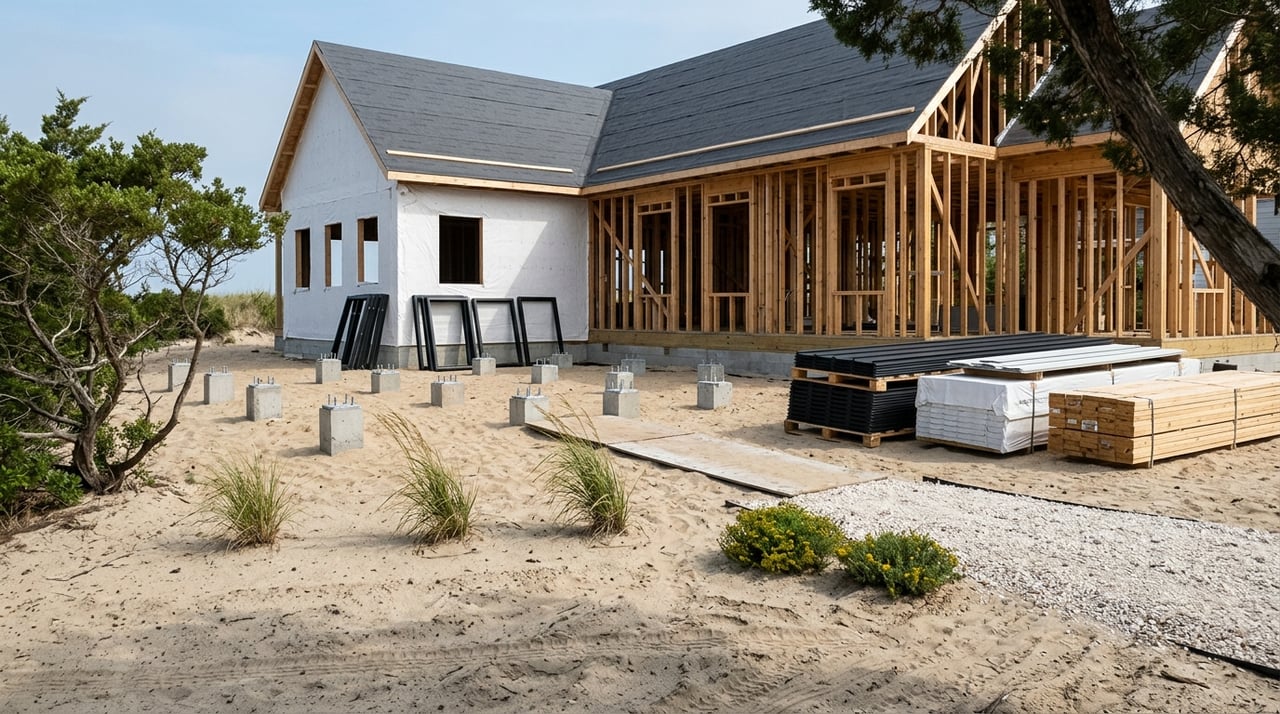
Thinking about building a custom home in Duck? It can be an exciting path, but it is also a process that rewards careful planning from day one. If you want more control over layout, finishes, and how your home fits the lot, understanding Duck’s local rules early can save you time, money, and stress later. Let’s dive in.
Why building in Duck takes extra planning
Duck is not a market where you can treat a lot like a blank canvas. The Town of Duck Department of Community Development handles planning, land-use, and building regulations, and many projects require permits beyond the main building permit.
That includes work like accessory structures, pools, hot tubs, HVAC work, land disturbance, and projects in special flood hazard areas. In practical terms, your build plan needs to account for much more than the house itself.
Water service in Duck comes from the Dare County Water Department, but sewage is typically handled by private septic systems. That means a lot may look great on paper, yet still need careful review for septic feasibility before you move too far into design.
Duck also makes it clear that you should not assume your contractor will handle every required permit. As the owner, it helps to know what approvals may apply and confirm who is responsible for each step.
Start with lot feasibility
Before you fall in love with a floor plan, make sure the lot can support it. In Duck, a current survey is one of the most important early documents for new residential construction.
For new builds and additions beyond an existing footprint, the town expects a current survey prepared by a North Carolina licensed land surveyor. The site plan needs to show details such as lot dimensions, setbacks, easements, driveways, parking, utilities, septic locations, flood zones, wetlands, shoreline features, dunes, and lot coverage.
This is where many big questions get answered. Can the lot fit the home size you want? Is there enough room for parking? Are there floodplain or coastal issues that affect placement or design?
Key zoning and site standards to review
For many standard single-family districts in Duck, the zoning chart shows these baseline standards:
- Minimum lot size: 15,000 square feet
- Minimum lot width at building setback line: 75 feet
- Front yard setback: 25 feet
- Side yard setback: 10 feet
- Rear yard setback: 25 feet
- Maximum lot coverage: 30 percent
- Maximum building height: 35 feet
Some nonconforming lots and certain districts may have different standards. That is why parcel-specific review matters so much in Duck.
Duck’s FAQ also notes that lot coverage is generally 30 percent, though some smaller older lots may allow more. In some cases, lot coverage may increase to 35 percent if stormwater improvements meet the town’s criteria.
Parking, vegetation, and site work matter too
Parking is part of the approval process, not an afterthought. For single-family detached and duplex homes, parking is based on one space for every two occupants authorized by the septic improvement permit.
The survey should show parking spaces that are 10 by 20 feet, with driveways at least 12 feet wide. If you are designing for a second home or vacation use, this can directly affect how the site is laid out.
Vegetation is another important piece. Duck’s planting guidelines require 15 percent vegetative canopy coverage on residential sites, and land-disturbance permits may be needed for grading, filling, driveways, parking areas, septic work, patios, walkways, and accessory buildings.
Understand coastal and floodplain constraints
In Duck, coastal rules are a major part of custom home planning. If your lot is near the ocean or sound, CAMA review may be part of the process.
The town notes that shorelines fall under CAMA jurisdiction. The Area of Environmental Concern includes the area within 75 feet of the normal waterline of the Currituck Sound and the oceanfront adjacent to the frontal and primary dune system.
Minor CAMA permits are handled by the town, while major and general permits are issued by the North Carolina Division of Coastal Management in Elizabeth City. For oceanfront projects, Duck requires an AEC Hazard Notice.
Oceanfront lots need earlier review
Oceanfront parcels often need more case-by-case analysis than interior lots. North Carolina oceanfront construction setbacks are based on long-term shoreline change rates, and the setback is measured from the first line of stable and natural vegetation or a pre-project vegetation line, depending on the parcel.
That means the buildable area on an oceanfront lot may be different than what you expect from a tax map or listing photo. If you are considering an oceanfront homesite, early review is especially important.
Flood zones can affect design and approvals
Floodplain review is another core step in Duck. The town states that updated FEMA flood maps and the local flood damage prevention ordinance became effective on June 19, 2020, and that a permit is required for most development in flood zones and up to a local elevation standard of 10 feet.
If your project is in a High Velocity V flood zone, Duck requires a V Zone Certification from a licensed North Carolina engineer or architect. This is one more reason your architect, engineer, builder, and surveyor should be aligned early.
Know the permit path before you design
Duck uses a consolidated Development Permit Application that can cover building, trade, floodplain, land disturbance, demolition, house moving, and sign permits. Depending on the lot and scope, you may also need supporting documents such as survey materials, contractor information, health-department approval, a CAMA permit, and a vegetation management plan.
The town recommends a pre-permit review with the Local Permit Officer before you file. That is smart advice, especially if you are still deciding between lot options or refining a house plan.
A pre-permit conversation can help surface issues before you spend more on final drawings. In a market like Duck, that kind of early coordination often makes the process smoother.
Do not skip the septic review
Because most properties in Duck rely on private septic systems, septic capacity can shape the entire project. It can affect occupancy, parking requirements, and what kind of home plan makes sense for the lot.
This is one of the most important reasons to evaluate a homesite before you commit to a design. A beautiful plan is only useful if the lot can support it.
Budget and timeline expectations
Custom construction usually gives you more control, but it also brings more moving parts. In Duck, that means you should budget time for survey work, septic review, floodplain review, possible CAMA review, and land-disturbance approvals before site work begins.
Nationally, the NAHB reports that the average single-family home took 10.1 months to complete in 2023. In Duck, that figure is best viewed as a floor rather than a local average because several local approvals may need to be cleared before excavation starts.
Duck’s fee schedule lists separate charges for building, floodplain, land-disturbance, CAMA, occupancy, and related items. The town also states that work started without a permit can be charged at double the required permit fee, and that construction must begin within six months or the permit expires.
Common local delay points
Some of the most common friction points in Duck include:
- Survey revisions
- Septic approval
- Floodplain review
- CAMA review
- Land-disturbance design changes
- Final as-built survey requirements
None of these issues mean you should avoid building. They just mean a successful project usually starts with realistic expectations and a well-coordinated team.
A practical checklist before you buy a lot
If you are thinking about building in Duck, here are smart early steps to take:
- Confirm the lot has a current survey or budget for a new one.
- Review setbacks, lot coverage, height limits, and parking requirements.
- Check flood zone status and whether V Zone certification may apply.
- Ask whether the property falls in a CAMA Area of Environmental Concern.
- Review septic feasibility and possible occupancy limits.
- Consider whether grading, driveway work, or clearing may trigger land-disturbance review.
- Speak with the Town of Duck early, ideally before finalizing your plans.
- Make sure everyone understands who is handling each permit and approval.
For remote buyers and second-home owners, this upfront planning can be especially valuable. It helps reduce surprises and creates a clearer path from lot purchase to finished home.
Why local guidance matters in Duck
Building in Duck is not just about choosing finishes or finding a builder you like. It is about understanding how surveys, setbacks, septic, floodplain rules, parking, vegetation, and coastal regulations all fit together on one specific parcel.
That is why local guidance matters so much here. When you have the right people involved early, it becomes much easier to evaluate whether a lot is truly a good fit for your goals.
If you are exploring a lot purchase or weighing whether to build versus buy an existing home in Duck, having a process-oriented local advisor can help you make a more informed decision. If you want help thinking through lot feasibility, builder coordination, and the next steps for a Duck property, connect with Jason Summerton.
FAQs
What should you check before buying a lot in Duck?
- You should review the current survey, setbacks, flood zone status, septic feasibility, lot coverage limits, parking requirements, and whether CAMA rules apply.
Are oceanfront lots in Duck harder to build on?
- Yes. Oceanfront lots often need earlier and more parcel-specific review because setbacks are based on shoreline change rates and vegetation lines.
Does Duck require more than a building permit for a custom home?
- Often, yes. Depending on the project, you may also need trade permits, floodplain review, land-disturbance approval, CAMA review, and other supporting documentation.
Why does septic matter for a custom home in Duck?
- Most properties in Duck use private septic systems, and septic capacity can affect occupancy, parking requirements, and the home design that a lot can support.
When should you contact the Town of Duck about a build?
- As early as possible, ideally before purchase and definitely before clearing, grading, or ordering final plans, since Duck recommends pre-permit review.
What can slow down a custom build in Duck?
- Common delay points include survey revisions, septic approval, floodplain and CAMA review, land-disturbance changes, and final as-built requirements.