Picture two Duck homes, each assessed at $1,000,000. For FY2026-27 the town and county general rates amount to $4,432 on either one. Put one of them inside the corridor between the US Army Corps of Engineers property and Oyster Catcher Lane, on the oceanfront, and the town, county and district rates together amount to $7,120. Neither listing will show the difference, and the cause is a pair of special tax districts that pay for beach nourishment.
Every Duck property does not share that cost equally. A defined slice of town pays it. Owners in that slice are also the most exposed to a regional decision that is still open as this post goes up, about how far apart the next rounds of sand should be.
Rates on the Same Assessed Value
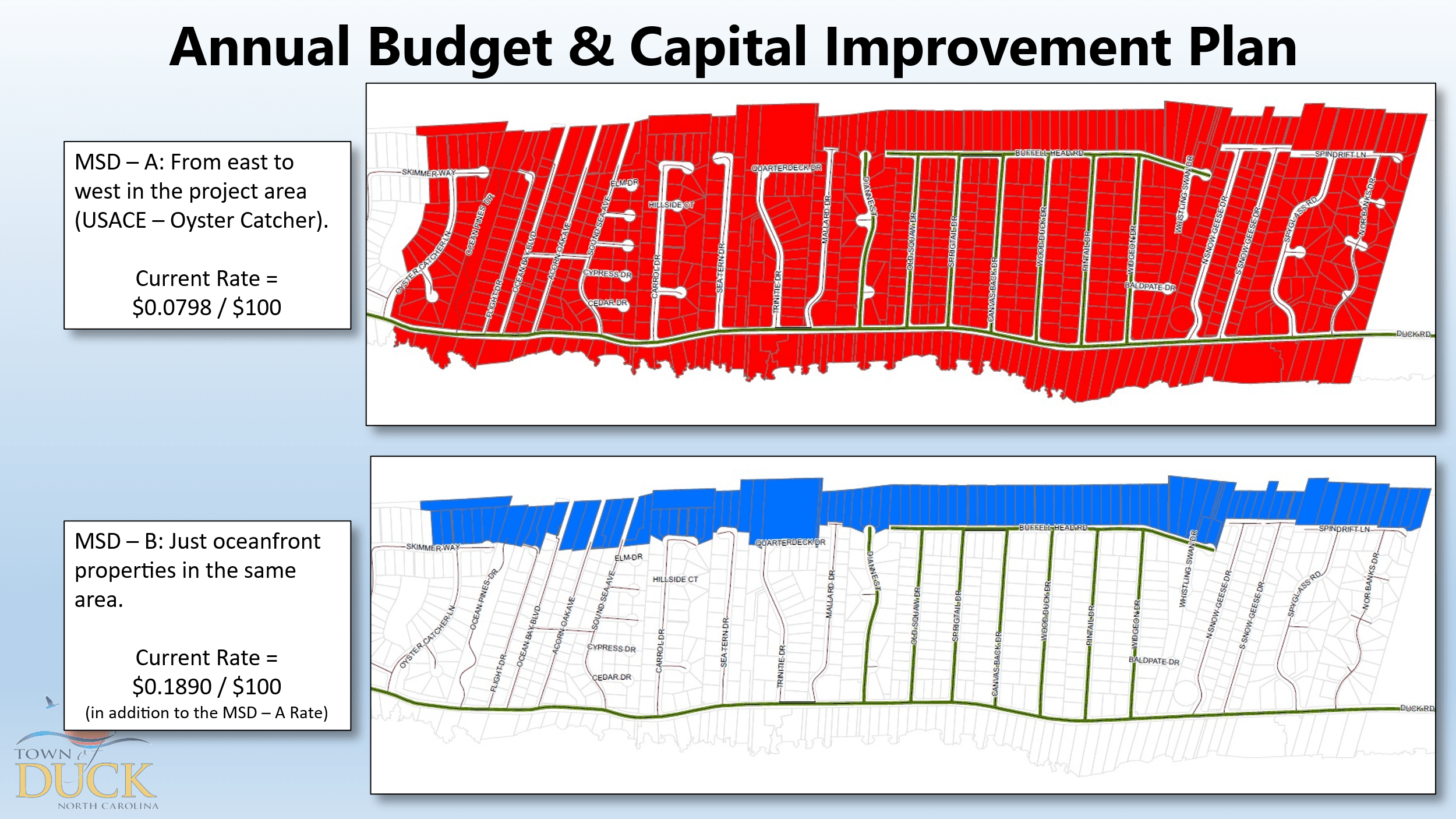
Duck's adopted FY2026-27 budget sets a general town rate of 18 cents per $100 of valuation. On top of that, it levies 7.98 cents in Municipal Service District A and 18.9 cents in Municipal Service District B. Dare County adopted its own general rate of 26.32 cents per $100 on June 9, 2026. The Town of Duck's tax page says MSD-A covers every property from the Corps property to Oyster Catcher Lane, and MSD-B covers only the oceanfront properties within that same stretch.
So the districts stack. An oceanfront lot inside the corridor pays both.
| Location in Duck, FY2026-27 | Rates applied, per $100 | Combined rate | Town, county and MSD taxes on $1,000,000 assessed |
|---|---|---|---|
| Outside the MSD corridor | Town 18 + County 26.32 | 44.32¢ | $4,432 |
| Inside the corridor, not oceanfront | Town + County + MSD-A 7.98 | 52.30¢ | $5,230 |
| Inside the corridor, oceanfront | Town + County + MSD-A + MSD-B 18.9 | 71.20¢ | $7,120 |
These figures use the general town and county rates and the two nourishment districts from the adopted budgets. They are based on assessed value, which is not the same as a sale price.
The Line Follows the Sand
The corridor exists because the sand only goes there. Duck has 5.9 miles of Atlantic shoreline. Its nourishment project, the Central Reach, covers about 1.6 of those miles, running from near 128 Skimmer Way down to the south property line of 137 Spindrift Lane, which is the northern edge of the USACE Field Research Facility. Those lengths come from the town's 2025 shoreline monitoring report. That works out to roughly 27 percent of the town's beach.
The tax base shows the same proportion. Duck's FY2026-27 budget values all taxable property in town at $3,202,404,815. It values MSD-A at $836,977,065 and MSD-B at $191,507,775. About 26 percent of Duck's valuation carries the district tax, and about 6 percent carries the oceanfront layer on top of it. The town publishes a map of both districts.
The other three quarters of Duck still contribute indirectly. Dare County's beach nourishment FAQ says its Beach Nourishment Fund receives 2 percentage points of the county's 6 percent occupancy tax, restricted by law to nourishment and related beach and dune work. Renters across the county pay some of the cost of every project.
Why the Rates Fell While the Projects Kept Coming
A buyer who looks at rate history might decide the district tax is shrinking. In FY2020-21, MSD-A was 12.96 cents and MSD-B was 28.5 cents, according to the town. Today's 7.98 and 18.9 cents look like a cut.
The town describes them as revenue-neutral rates set after the 2025 revaluation, which it says added approximately $1.2 billion to Duck's tax base. When values rise, the rate can drop and still raise the same money. In FY2026-27, the two districts are budgeted to send $1,029,445 into Duck's Beach Nourishment Capital Reserve Fund, and $280,422 in restricted sales-tax revenue goes in alongside it.
The town also explains what sets these rates. They are designed to cover debt service on nourishment projects and are reset every year during budgeting. When the tax page was published in August 2025, the town said its modeling showed no need to raise MSD rates for upcoming debt service, and added that future rates may change depending on debt requirements for future projects, "including the next cycle in 2027." The rate in place at closing is a snapshot of one budget year, and the next cycle's financing has not been reflected in it yet.
Duck Is Going Back After Four Years, and Mobilization Explains Why
Duck built the Central Reach in 2017, placing about 1.26 million cubic yards of sand. Its first renourishment placed about 576,800 cubic yards in 2023. That 2023 date was supposed to be 2022. Coastal Review reported in November 2022 that the contractor, Weeks Marine, cited equipment issues, minor weather delays and a commitment to another time-sensitive job, and that the work was then expected around mid-March 2023.
Duck is now scheduled to go back on the beach in 2027, four years after that renourishment, alongside Southern Shores, Kitty Hawk and Kill Devil Hills. Equipment explains the grouping. The Outer Banks Voice reported on August 1 that bringing equipment to the site costs the same whether it serves one town or four, so the towns share that cost, and each town's portion is based on how much sand is pumped onto its beach. The same report says Dare County shares 50 percent of nourishment costs with the towns overall.
Duck's project page lists this schedule, and notes that every date is anticipated and may change:
- Construction plans and specifications, March through July 2026
- Bid solicitation, August through September 2026
- Contract award, September through October 2026
- Construction on the beach, May through October 2027
The council recaps from Duck's September 2 and October 7 meetings list no nourishment vote.
The Interval Decision Lands Hardest on Duck's Reach
The four towns are weighing how long the 2027 sand should be expected to last. According to the Outer Banks Voice, Coastal Protection Engineering's monitoring found the 2022 projects in the other towns had held up well enough to consider six or seven years between projects instead of the usual five. The combined project would cost $42.5 million on a five-year plan, $43.9 million on six and $45.4 million on seven. The Voice put the savings at about $1.2 million per year on a six-year interval and about $2 million per year on seven.
Duck's beach is the exception. The Voice reported that Duck's nourished reach is not performing as well as the other towns' beaches, though it still meets the project's design criteria. For a six- or seven-year project to last, Duck would need to pump 16 to 31.5 percent more sand than the five-year plan calls for. That would still save money per year, but the upfront cost would be significantly higher. Each town pays for mobilization according to how much sand it takes, so more sand in Duck means a larger Duck share of the bill. That cost comes due in a single project, and the corridor's tax districts are the vehicle the town uses to pay for nourishment.
Duck Mayor Monica Thibodeau described the town's position to the Outer Banks Voice:
"We're holding our breath that the six-year number will be the number they settle on. Seven is a holding-your-breath type of thing. If we have to, we have to, because we have to go with the group."
The group has not locked in yet. The Southern Shores Beacon reported on July 15 that Southern Shores' council approved $62,553.75 for pre-construction engineering without an unequivocal commitment to the 2027 project. No Duck-specific 2027 cost or sand volume has been published.
What to Watch for Duck's 2027 Project
Duck's next nourishment cycle has several moving parts:
- Read the line in the town's tax explainer about 2027. The town has said future MSD rates depend on the debt needs of the next cycle.
- Follow the interval decision and the contract award. Both affect how much sand Duck buys in 2027 and how long it has to last.
- Plan around construction. Duck's project page says to expect heavy equipment, temporary access restrictions and active work zones during the May through October 2027 window.
Quick Answers
Does the nourishment only protect the corridor that pays for it? The sand is placed on the Central Reach, but the town says its monitoring program tracks the health of the beach along all of Duck.
Is the money in the MSD reserve fund available for other town spending? The town's budget restricts MSD revenue to beach nourishment, and FY2026-27 receipts are budgeted into the Beach Nourishment Capital Reserve Fund.
When will the 2027 schedule be final? Duck's posted timeline put contract award in September through October 2026, and construction dates for all four towns are still listed as to be determined.
This post is general information about published tax rates and town plans. It is not tax, legal or financial advice, so please confirm your own property's bill with the Dare County Tax Department, which the town lists at 252.475.5940, or with your own tax professional.
If you're comparing Duck homes and want to discuss the 2027 timeline, Jason Summerton can help. Let's Connect.