Ask anyone who spends their summer on the 4x4 beaches when the season ends, and most will say Labor Day. That's the assumption baked into every rental turnover schedule and every "see you next year" conversation on the sand. It's also wrong, or at least incomplete, if you actually live here.
Carova runs on three separate deadlines this month, not one, and they don't land on the same day. The dune-line driving restriction lifts on Labor Day. The county's parking permit requirement keeps going for another nineteen days after that. Sea turtle patrols don't stop for either of them. And underneath all three, the wild horse herd has been running its own calendar all summer, one that doesn't consult a county ordinance or a holiday weekend. If you've been treating Labor Day as the single line between season and off-season, you've been missing most of what actually changes.
The Three Deadlines
Here's what actually expires, and when, for anyone driving or parking on the Carova beach this September:
| Rule | Ends in 2026 | What Actually Changes |
|---|---|---|
| Dune-line driving lane restriction (Milepost 14.5 to 17, 9am to 5pm) | Labor Day, Monday, Sept. 7 | Vehicles are no longer confined to a single lane near the dune during daytime hours. You can use the shoreline lane at any time. |
| County beach parking permit requirement | Last Saturday of September, Sept. 26 | No permit is required to park on the sand after this date. Before it, you still need one. |
| Sea turtle nesting activity (Virginia line to Nags Head) | Tapers through September, no fixed stop | NEST volunteers keep patrolling as long as nests are still incubating, regardless of what the calendar says about beach traffic. |
Two of those three are set by Currituck County. One of them belongs to a sea turtle.
The Nineteen-Day Gap
The gap between the first deadline and the second is the part most people get wrong. On Labor Day, the dune-line lane restriction disappears, so it feels like the beach has gone into off-season mode. But the parking permit is still required for another nineteen days, all the way through Sept. 26, the last Saturday of the month. If you're driving out to the beach with guests or contractors during that stretch, you can drive more freely than you could in July, but you still can't park without a permit.
That distinction matters if you're the one handing off parking permits to guests or managing a self-managed rental. Properties in the 4x4 area with a dwelling can pull two additional beach parking permits from the Corolla Visitors Center at 500 Hunt Club Drive, and if the house is in a rental management program, the management company distributes those to guests directly. Self-managing owners have to do it themselves, and the requirement doesn't quietly end just because the driving restriction did. Nineteen days is a long time to keep telling arriving guests they need a permit for a beach that already feels like it's closed for the season.
The Season That Won't Follow the Calendar
Sea turtles don't care about county ordinances at all. Nesting season on the Northern Outer Banks, the stretch NEST tracks from the Virginia state line down through Nags Head, has traditionally run into September, with the last nests of the year hatching well after the parking lot empties out. This year gave that pattern extra weight: as of late August, NEST had logged 56 nests along the Northern Outer Banks, the most since counting began in 2009, and the organization said plainly that "the season's not over yet."
That record includes activity in the 4WD area of Currituck, which means Carova is part of the reason this was a record year, not a footnote to it. For residents, the practical read is simple: don't assume the beach is done being a nursery just because the parking lot signage has changed. NEST's volunteers, easy to spot in bright green shirts, are still working the sand into the fall, and their 24-hour hotline (252-441-8622) is still the right call if you find a turtle or a nest in distress.
The Herd Doesn't Read a Calendar Either
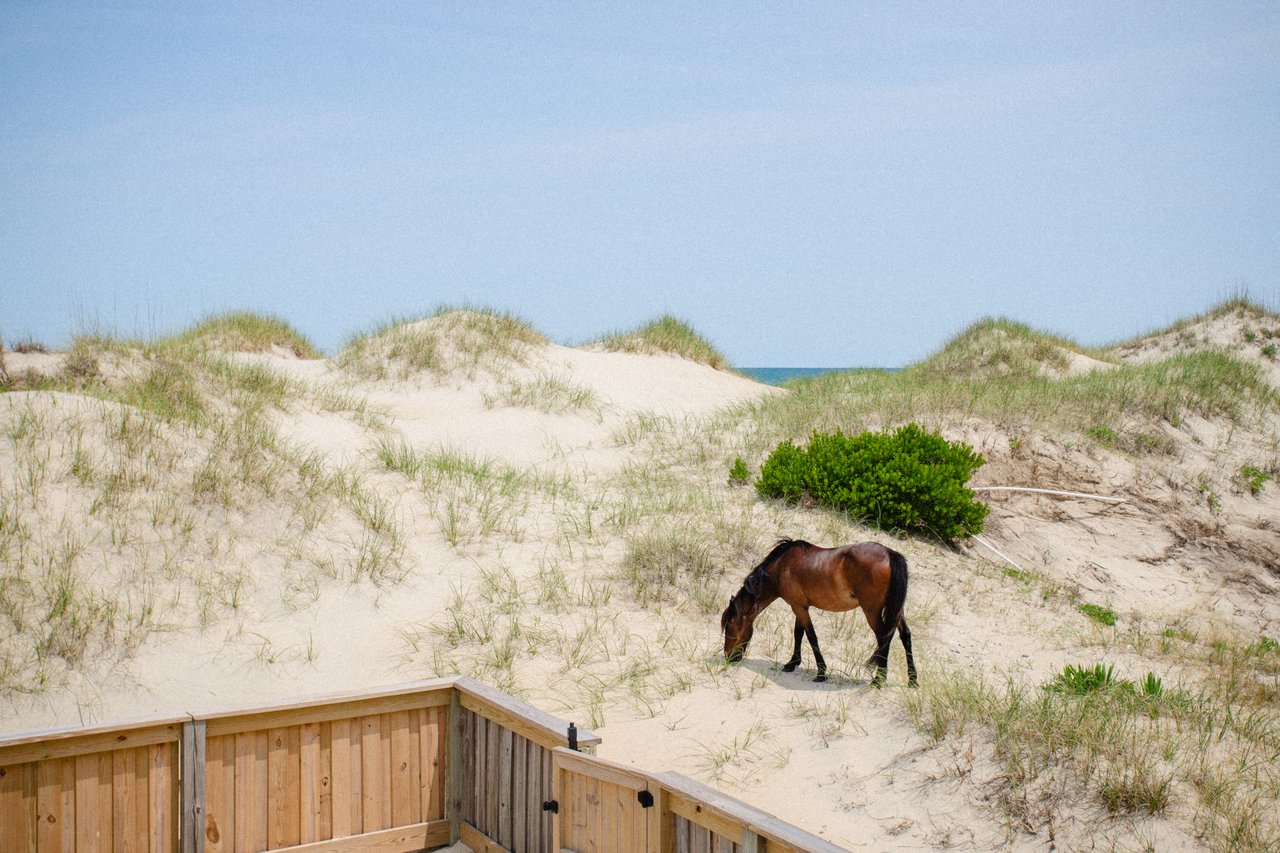
If the driving lane, the parking permit, and the turtle season are three overlapping human deadlines, the wild horse herd is the fourth clock, and it's the one that never synced up with the other three in the first place. This has been an eventful year for the herd, and most of it happened on nobody's schedule but the horses' own.
A few things worth knowing if you've been watching the herd from your own porch this summer:
- The Corolla Wild Horse Fund counted ten new foals this year, four colts and six fillies, with the organization noting the busiest part of foaling season had passed but a couple more arrivals were still possible.
- The herd lost two notable stallions this summer. Surfer, a 15-year-old, died June 16 after a fatal kick to the head. Topnotch, a stallion in his 30s, well past the typical lifespan for a wild horse, died in late July after sudden acute colic. His sire was Croatoan, and his dam is still alive in the wild.
- In June, the Wild Horse Fund issued a public warning about drone disturbance to the herd after a tour guide captured a horse reacting fearfully to one overhead. Currituck County's Wild Horse Ordinance already requires staying at least 50 feet away from the horses, and the fund made clear that distance rule applies to drones too.
None of that happened in September, and none of it is going to happen again on any predictable date. That's the point. The herd's calendar runs on foaling cycles, age, and territory, not on the second Saturday of May or the last Saturday of September. Anyone who has lived here long enough knows the horses were the original reason this stretch of beach never felt like it belonged to a tourist season at all.
What This Actually Means for September
Put the four clocks next to each other and a pattern shows up that a single "Labor Day ends it" mental model completely misses. The driving restriction lifts first, in the first week of September. The parking permit keeps going for nearly three more weeks. The turtles keep nesting past both of those dates, on their own unannounced schedule. And the horses, foals included, keep doing what they've been doing all summer, indifferent to every one of the human deadlines layered on top of their home.
If you live in Carova, the practical move isn't to treat Labor Day as a finish line. It's to track the actual sequence: drive more freely starting Sept. 7, keep the permit in the glovebox through Sept. 26, expect NEST vehicles on the sand well after that, and don't assume the herd is doing anything predictable at all. The beach doesn't close in one motion. It unwinds in stages, and the horses were never on that schedule to begin with.
If you're weighing what any of this means for a property here, whether you already own on this stretch of sand or you're trying to understand how a place like Carova actually operates day to day, Jason Summerton has spent his career inside exactly this kind of detail. Let's Connect.