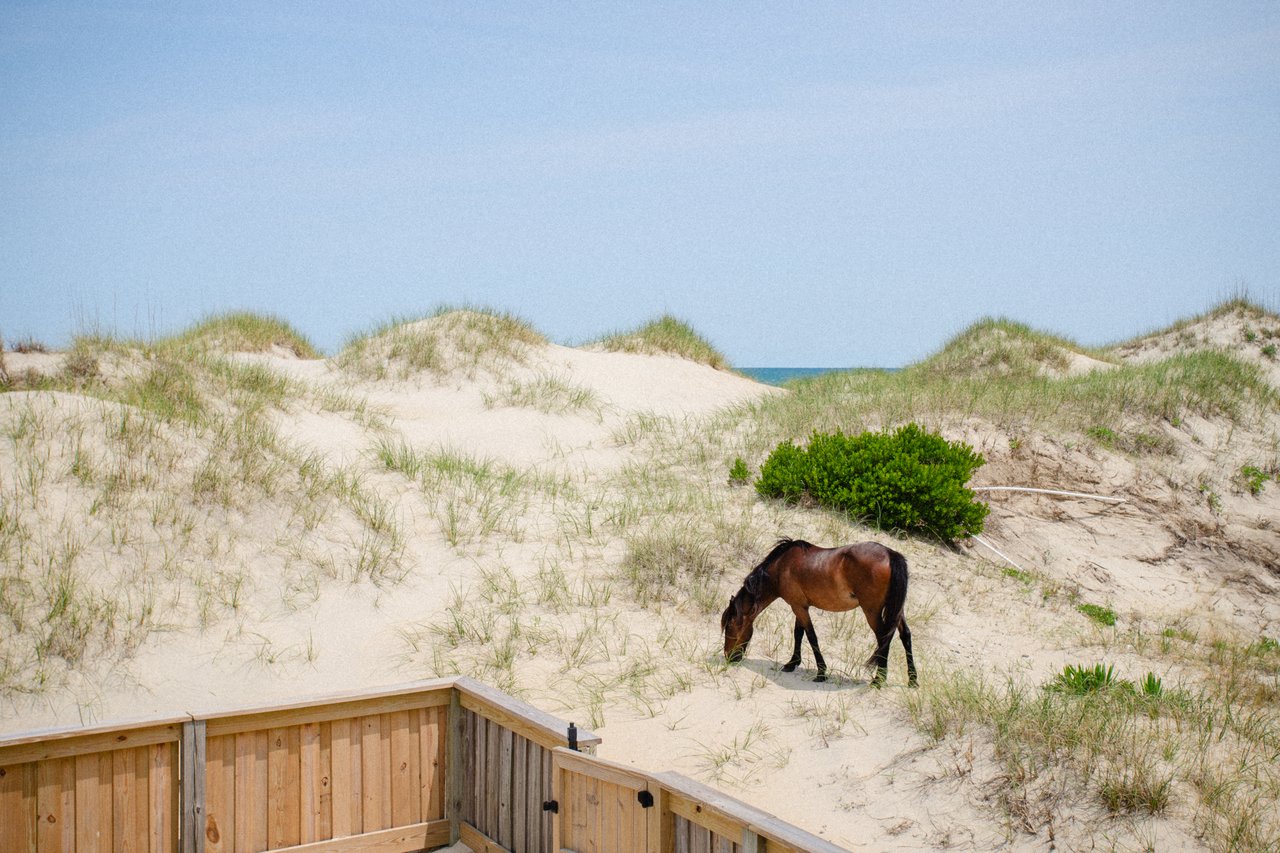
If you live north of the 4x4 ramp, you probably saw both posts land in your feed within six weeks of each other. First Surfer, a stallion killed instantly by a kick from another horse in mid-June. Then Topnotch, a stallion in his thirties who had to be euthanized in late July after a sudden bout of colic. Two names, two obituaries, two waves of comments from people who've watched these horses graze past their decks for years. It's easy to read that as a bad summer for the herd.
That may feel like a bad summer, but two deaths alone don't tell us whether the herd's population is holding steady.
While Surfer and Topnotch were dying, the herd was also having one of its more active foaling stretches in recent memory. As of the Corolla Wild Horse Fund's most recent count, twelve foals have been confirmed in 2026, seven fillies and five colts, arriving in a rough sequence that included four in April, three in May, one in June, and two in July, with the twelfth showing up in a marsh-dwelling group that rarely comes out where staff can see them. Topnotch had already been removed from the wild herd, so his death should not be counted as a loss from that population. The twelve confirmed foals describe the herd's births, but those numbers alone do not establish whether its population is holding steady.
Two Different Kinds of Loss
The two deaths this summer weren't really the same story, and the difference matters if you're trying to understand what the herd is actually up against.
Surfer died the way wild stallions have always died here: competing with another horse, in the open, with no human involvement at all. That's harem dynamics. Stallions fight over mares, and sometimes a kick lands wrong. It's brutal to watch play out in real time on a neighborhood Facebook group, but it's not evidence of anything going wrong with the land, the food supply, or the fence line. It's just what it costs to be a wild horse.
As WAVY reported, Topnotch's death was a different category entirely. He'd already been pulled from the wild in November 2025 and relocated to the Fund's farm sanctuary in Grandy, the Betsy Dowdy Equine Center, before he ever got sick. When he started showing signs of acute colic on a Monday morning in late July, a vet was on site within fifteen minutes, and the decision to euthanize came fast because his condition was deteriorating that quickly. A necropsy later suggested testicular torsion, possibly linked to cancer. That's an aging-animal story, the kind of thing that happens to any horse who lives into his thirties, wild-born or not. The Fund noted his age put him well past a typical wild stallion's lifespan.
The two deaths this summer were different kinds of loss. Surfer died in the wild, while Topnotch died after being removed from the herd and placed under veterinary care. Those losses alone do not establish how the underlying population is doing.
What Topnotch Actually Leaves Behind
The WAVY report also notes another detail about Topnotch's legacy. Topnotch himself sired very few confirmed foals. His only documented offspring is a mare named Kitty Hawk, who has since had two colts of her own, one of which is still alive in the wild herd today. On paper, that's a thin legacy for a stallion who held a large harem for most of his adult life.
But Topnotch's sire was Croatoan, and Croatoan was, by the Fund's own account, a prolific stallion whose genetics are already spread widely through the population. That's the piece worth sitting with if you're trying to figure out why losing a well-known, long-tenured stallion doesn't actually put a dent in the herd's genetic health. In a population this small and this geographically closed, with roughly 7,500 acres split between public and private land, and no way for new bloodlines to walk in from outside, the founder lines run deep. A stallion's individual harem record matters less than which bloodline he's carrying forward, because that bloodline is likely already represented a dozen other ways through cousins, half-siblings, and previous generations. Losing Topnotch doesn't erase Croatoan's genetics from Carova. It just means one carrier of them is gone, and there are others.
That's not a reason to shrug off a death that clearly affected the people who cared for him. It's a reason to understand why the Fund can report both a loss like this and a healthy foal count in the same season without those two facts contradicting each other.
The Twelve Nobody's Naming Yet
The foals don't get the same kind of public mourning or memorial post that Surfer and Topnotch got, and that's partly just how attention works. A named, adult stallion with years of harem history and thousands of photos taken by visitors is a character people already know. A three-week-old colt spotted once in a marsh, mostly hidden from view because that family group rarely comes out where people can see them, doesn't have a name yet and won't for a while.
But that quiet arithmetic is the real story of the herd's year. Twelve new animals, arriving steadily from April through at least early September, is a longer and more spread-out foaling window than the Fund described for the previous year, when most births were done by mid-May with only a straggler or two showing up later in the fall and winter. This year's later births, including the marsh foal that showed up during a September heat advisory with the heat index pushing past 100 degrees, suggest a season that kept producing well past when it usually winds down.
If you're the kind of resident who tracks these things the way some people track osprey nests, the births are worth watching alongside the losses. The deaths tell different stories: Surfer died in the wild, while Topnotch had already been relocated. The twelve births describe the herd's foaling season, but they do not offset both deaths.
What's Left on the Calendar
For anyone who wants a closer look before the season fully turns, the Fund's Grandy farm has one more open house before its fall schedule kicks in, followed by a dedicated fall open house set for November 7. It's also worth knowing, especially if you're hosting guests with drones this fall, that the Fund issued a public reminder in late June about how disruptive drones are to the horses after a tour guide documented one visibly spooked by an aerial camera. The Currituck County Wild Horse Ordinance's 50-foot buffer applies to drones as much as it does to a person walking up on foot.
And if you missed it back in May, the Fund also premiered a new short documentary, From the Sound to the Sea, at the Pioneer Theater in Manteo, with CEO Chris Winter and Director of Herd Management Meg Puckett on hand for a panel discussion afterward. It's a good watch for anyone who wants the longer arc behind this summer's headlines: how a herd managed as a closed, protected population since the 1990s developed genetic depth, and why one season's births and losses alone can't tell the whole story.
If you're weighing a move up here yourself, or thinking about what it actually means to own property where horses graze past your front steps most mornings, I'm always glad to talk through what that day to day reality looks like beyond what you'd read on a listing sheet. You can reach Jason Summerton any time.
This article is general information, not legal, tax or financial advice. Consult a qualified professional about your situation.